About Delhi
Area: 1,483 Sq km
Population: Around 10 Million
Altitude: 216 mts above sea level
Climate: Summer Months > May - June > Temps as High as 116
F
Winter
Months > Oct - Feb > Temps as low as 41 F
Historical temps for Dec. 18-23 '03: High of 60F, Low of 51F
More historical temperature archives > wunderground.com
Sites with more information on Delhi
(where we found a lot of what is posted here):
> from
Indax
> Lonely
Planet tourism guide on India
> Lonely
Planet guide on Delhi
> Travelovista.com
> Tourisminindia.com
> things to see in Delhi
> Delhi
Tourism.com
> Tourism-delhi.com
> Delhi-tourism-india.com
> North-india.net
> Northindiatourism.com
History
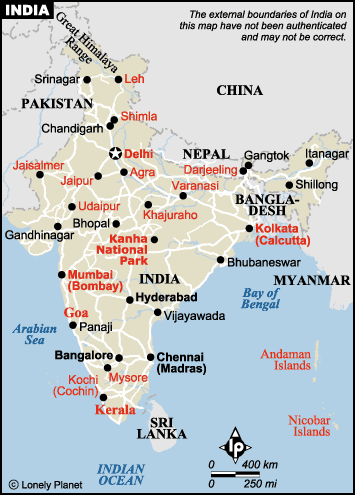
Delhi is the capital city of the Federal Republic of India.
It is one of India's fastest growing cities and has sprawled over
the West Bank of the river Yamuna, straddling the river. The city
has two distinct parts, Old Delhi & New Delhi. Old Delhi is centered
on the Red Fort built by Emperor Shah Jehan between 1636 & 1658.
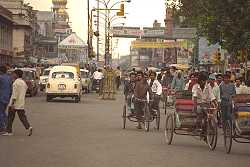 The
streets of Old Delhi are narrow & bustling. The beauty & serenity
lies inside the courts of the main buildings. Delhi has some of
the finest museums in the country. Its boutiques and shopping
arcades offer access to a wealth of traditional and contemporary
crafts, from all over the country. New Delhi was proclaimed the
capital of India by the British architect Sir Edwin Lutyens (1869-1944),
& is tree-lined & spacious.
The
streets of Old Delhi are narrow & bustling. The beauty & serenity
lies inside the courts of the main buildings. Delhi has some of
the finest museums in the country. Its boutiques and shopping
arcades offer access to a wealth of traditional and contemporary
crafts, from all over the country. New Delhi was proclaimed the
capital of India by the British architect Sir Edwin Lutyens (1869-1944),
& is tree-lined & spacious.
One of the most fascinating aspects of Delhi is the "visibility"
of its historic past. Were it not for the demands of urbanization,
large portions of the city could well be earmarked as archaeological
parks. This is because the rulers of successive dynasties between
the 13th and the 17th centuries established seven cities in different
parts of Delhi. A chronological review of these cities fortunately
also serves as a suitable itinerary for tourists and highlights
the important monuments amongst the 1300 officially listed.
Delhi's history goes much further back in time than the 13th
century. In 1955, excavations at the Purana Qila revealed that
the site was inhabited 3000 years ago.
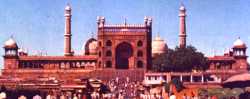 Delhi
is a city where an empire rose and fell before the dawn of history;
where citadels of emperors appeared and disappeared; a city of
mysterious eternity whose old ruins proclaim a majestic and imperial
past.
Delhi
is a city where an empire rose and fell before the dawn of history;
where citadels of emperors appeared and disappeared; a city of
mysterious eternity whose old ruins proclaim a majestic and imperial
past.
Delhi's history begins with the creation of the city of Indraprastha
by the Pandavas in 1500 BC and encompasses all the various kings
and emperors who fixed their royal citadels here-- Indraprastha,
Lal Kot, Quila Rai Pithora, Siri, Jahanpanah, Tughlakabad, Ferozabad,
Dinpanah, Delhi Sher Shahi or then Shahjahanabad. Combined and
integrated into one, these 'new cities' have always been called
Delhi and howsoever many names it may have acquired, Delhi has
always been intrinsically identified with power and imperial sway.
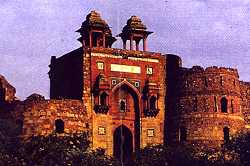 So
there have been at least eight cities around modern Delhi, and
the old saying that whoever founds a new city at Delhi will lose
it has come true every time -- most recently for the British who
founded New Delhi in 1911. The historic Purana Qila, which has
stood witness to Delhi's rejuvenation, periods of anarchy, and
the rise & fall of empires, brings alive history of the capital.
So
there have been at least eight cities around modern Delhi, and
the old saying that whoever founds a new city at Delhi will lose
it has come true every time -- most recently for the British who
founded New Delhi in 1911. The historic Purana Qila, which has
stood witness to Delhi's rejuvenation, periods of anarchy, and
the rise & fall of empires, brings alive history of the capital.
Delhi was the focal point for the first war of independence in
1857. Though the revolt did not reach its desired conclusion,
Delhi became a thorn in the eyes of the British. Not only in ancient
times or the mediaeval period, Delhi has been the center of any
activity at all times. As the Britishers shifted their capital
from Calcutta to Delhi, all the activities during the freedom
struggle were directed towards Delhi. Thus, Delhi also bears the
marks of the freedom struggle.